 English
 العربية
 Français
 Deutsch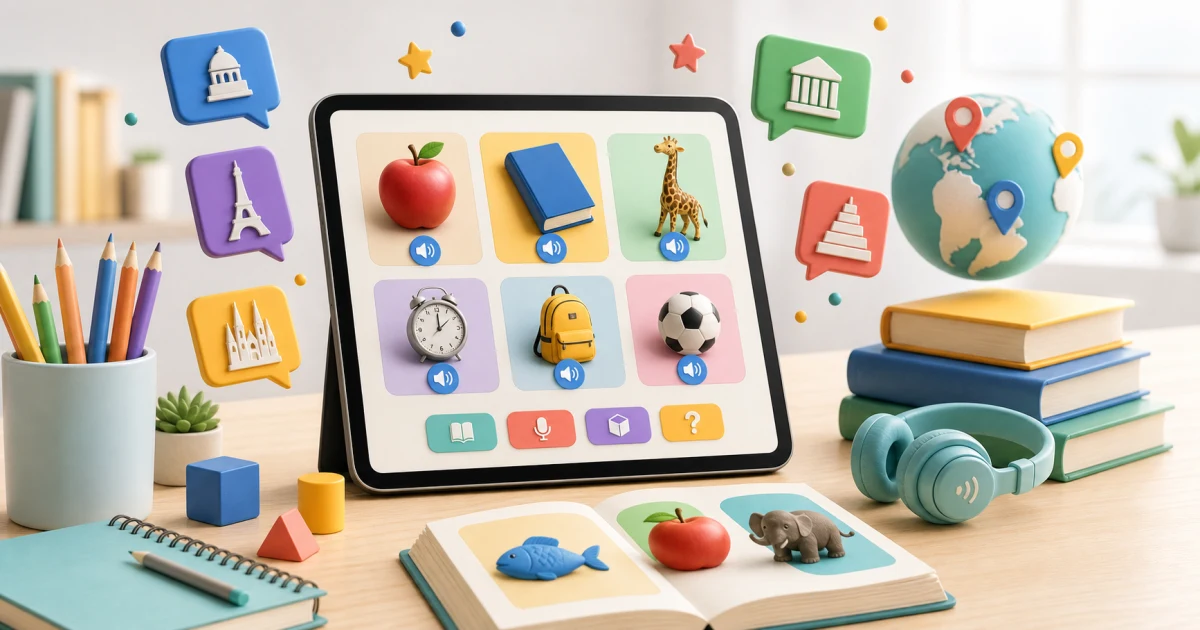
Why a 3D dictionary helps children learn words
Children often learn vocabulary faster when a word is connected to something they can see, hear, and interact with. A flat word list can work for review, but it rarely feels memorable. A 3D dictionary app adds a visual anchor: the word, the object, the pronunciation, and a short activity can all appear together.
IGY Apps includes several language learning apps built around this idea, including 3D Dictionary Arabic-English, 3D Dictionary Arabic-French, and 3D Dictionary Arabic-German. The wider Discover 3D family also covers Arabic, English, French, Spanish, and German vocabulary for children.
What makes the format useful?
The value is not only the 3D model. The helpful pattern is repetition through different senses. A child can see an object, hear the pronunciation, search for a word, answer a quiz, and earn stars or rewards. That creates a learning loop without turning vocabulary practice into a long worksheet.
For parents, this format is practical because it supports short sessions. Five to ten minutes can be enough to review animals, colors, school items, food, tools, or family words. For teachers, it can work as a warm-up, station activity, or quick review after introducing new words.
Arabic with English, French, or German
The Arabic-based 3D dictionary apps are especially useful for bilingual families and classrooms. Children can connect Arabic vocabulary to English, French, or German equivalents while keeping the object visible. This helps when a child knows the object in one language but needs to attach a new word in another.
The apps focus on accessible vocabulary areas: letters, numbers, animals, colors, food, school objects, jobs, clothes, weather, technology, and daily tools. These are the words children meet in real life, so they are easier to practice outside the app.
Tips for better practice
Do not try to cover too many words in one session. Choose one category, repeat the words aloud, then ask the child to find the same objects around the room.
Use pronunciation actively. Listening is useful, but repeating the word is what builds confidence. If the app includes voice or pronunciation feedback, use it as a friendly check, not as a pressure test.
Return to old words. Vocabulary grows through review. A quick revisit after a day or two is often more useful than a long first session.
Which app should you start with?
Start with the language pair your child needs most. If Arabic and English are the main languages at home or school, open 3D Dictionary Arabic-English. For French learners, use 3D Dictionary Arabic-French. For German learners, try 3D Dictionary Arabic-German.
If the goal is broader early vocabulary, the Discover 3D apps can help children explore one language through categories, tracing, quizzes, pronunciation, and rewards.
A practical learning habit
The best use of a 3D dictionary is not a long session once a week. It is a small daily habit: choose a category, learn a few words, hear them, say them, answer a short quiz, and return tomorrow. That steady rhythm makes language learning easier to keep.