 English
 العربية
 Français
 Deutsch
Jana was nine. She loved reading, drawing, and skipping-rope races in the schoolyard. She did not finish everything with magical speed. She simply knew how to divide her day: homework time, family time, playtime, and a little time for a program she chose.
One morning, Ms. Amal asked the class, "What helps when you have many things you want to do?"
"I begin with anything that has a deadline," Jana said, "then choose something fun afterward."
Ms. Amal liked the idea. She reminded the class that every child might use a different plan. What mattered was noticing how a choice affected sleep, concentration, and mood.
Cloud City
At recess, Salma hurried over to talk about an animated series called Cloud City. She described a train that flew between islands and a tiny guard who repaired a rainbow bridge.
"What did you think of the ending?" Salma asked.
"I haven't seen it," Jana replied. "I watch television sometimes, but I haven't started that series."
Salma looked surprised. "You missed the funniest part! Everyone will discuss the new episode tomorrow."
Salma did not mean to make her uncomfortable, but Jana felt left outside the conversation. When she returned home, she decided to watch one episode so she could join in.
She placed her schoolbag beside her desk and told her mother, Dina, "I'll watch one episode. Then I'll finish my homework and help set the table."
Jana settled onto the sofa. The flying train was fast, and the colorful islands were wonderful. When the episode ended, another began immediately.
"I'll watch only the beginning," Jana told herself.
The beginning ended with a fascinating question. "Only a little" became a full episode and then half of another. By the time Mum announced dinner, Jana's homework notebook was still closed.
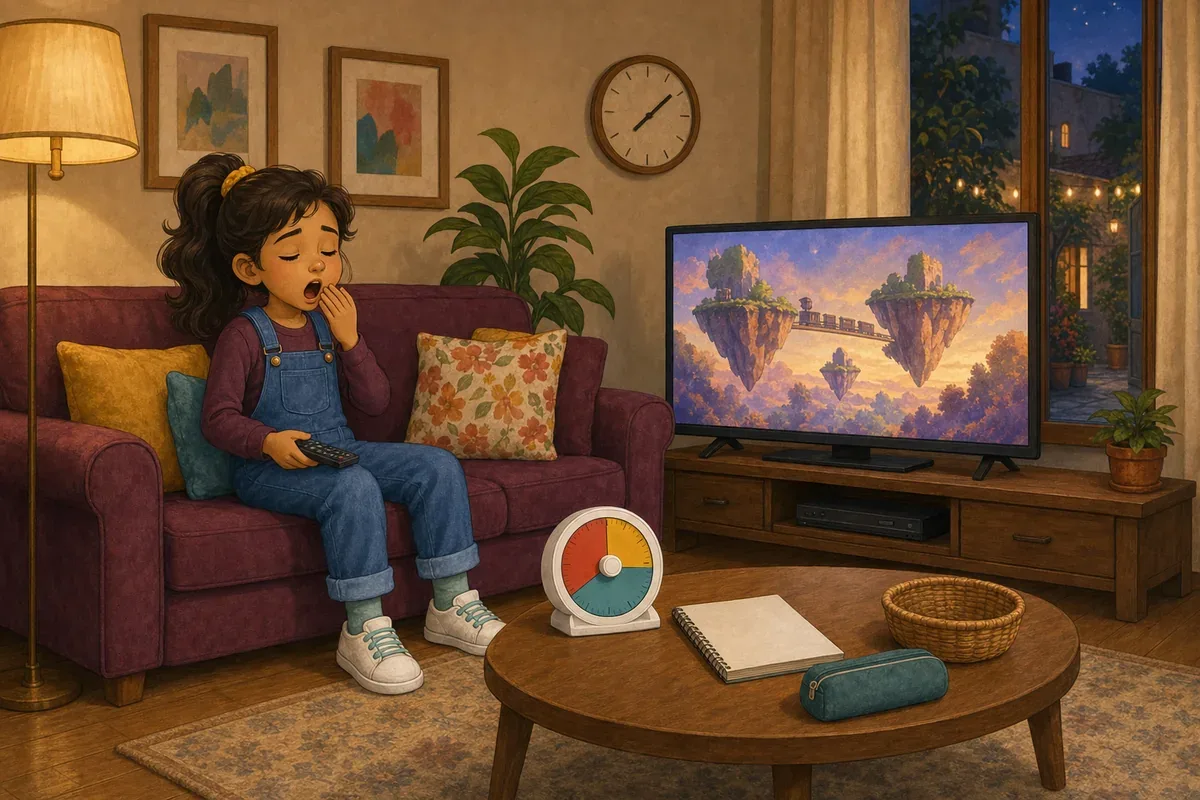
Jana switched off the television and rushed to her desk. She wrote too quickly, forgot to check a maths problem, and went to bed late with the flying train still circling in her thoughts.
A Slow Morning
The next day, Jana's eyes felt heavy. She read a question twice without understanding it and discovered that she had forgotten the colored pencil she needed.
Ms. Amal did not scold her. She sat nearby and asked, "Are you all right today?"
Jana explained what had happened. Salma overheard her.
"That happens to me too," Salma admitted. "I say one episode, and then the time seems to disappear."
Ms. Amal drew three circles on a sheet of paper. Inside them she placed wordless pictures: choosing eyes, a clock, and a completed task.
"A screen isn't an enemy," she said, "but it doesn't know your plan. Before you turn it on, ask three questions: What will I watch? When will I stop? What needs to be finished first?"
Salma suggested one more question. "What will I do after I turn it off? I start another episode when I don't have another idea."
Ms. Amal smiled. "Excellent. A useful plan opens the door to the next activity instead of only closing the screen."
The Balanced-Day Wheel
During activity time, Jana and Salma made wheels from sturdy card. They used no words, only small pictures: a book for homework, a plate for helping at home, a television for a chosen program, a ball for movement, and a moon for winding down before sleep.
They added a movable arrow and arranged the pictures to suit their own days. The two wheels were not identical. Salma had swimming practice, while Jana liked drawing after school.

At home, Jana showed the wheel to her mother. Together they made a simple plan:
- Finish homework and one home responsibility first.
- Choose the episode before turning on the television.
- Set a timer for thirty minutes.
- Put the remote in its basket when the timer rings.
- Keep the last hour before bed quiet and screen-free.
On the first day, the timer rang at the most exciting moment. Jana reached for the remote and nearly added ten more minutes. Then she noticed the ball card and remembered that her brother was waiting in the yard.
"I'll discover the rest tomorrow," she told the screen. "The adventure won't fly away, even if I do!"
She turned off the television, put away the remote, and went outside. After dinner, she drew her own flying train and gave it a carriage containing a tiny library. The program had offered her an idea, and stopping gave her time to make that idea her own.
At recess the next day, Jana and Salma discussed the episode. Jana had not watched every installment, but she still joined in with a question, a drawing, and a different ending she had imagined.
"Maybe enjoying a show doesn't mean watching everything at once," Salma said.
"Television can be a wonderful window," Jana replied, "but it doesn't need to become the whole timetable."
The plan did not work perfectly every day. Sometimes Jana needed a reminder. On some weekends, the family chose a longer film together. But Jana learned to pause, ask, and adjust instead of letting the next episode make every decision for her.
What We Learn
- Television and other screens can be fun and useful when we choose thoughtfully.
- Choosing content and a stopping time beforehand is easier than deciding during an exciting moment.
- Sleep, responsibilities, movement, and family time all belong in a balanced day.
- Feeling left out of a conversation does not mean we must watch everything.
- A good plan can change and does not have to be perfect.
Discussion After Reading
- Why did Jana decide to watch Cloud City?
- How did one episode become much longer than she planned?
- What three questions did Ms. Amal suggest asking before screen time?
- Why did Salma add a question about the activity after television?
- Which pictures did Jana put on her balanced-day wheel?
- Design a short screen-time plan for one of your school days.