 English
 العربية
 Français
 Deutsch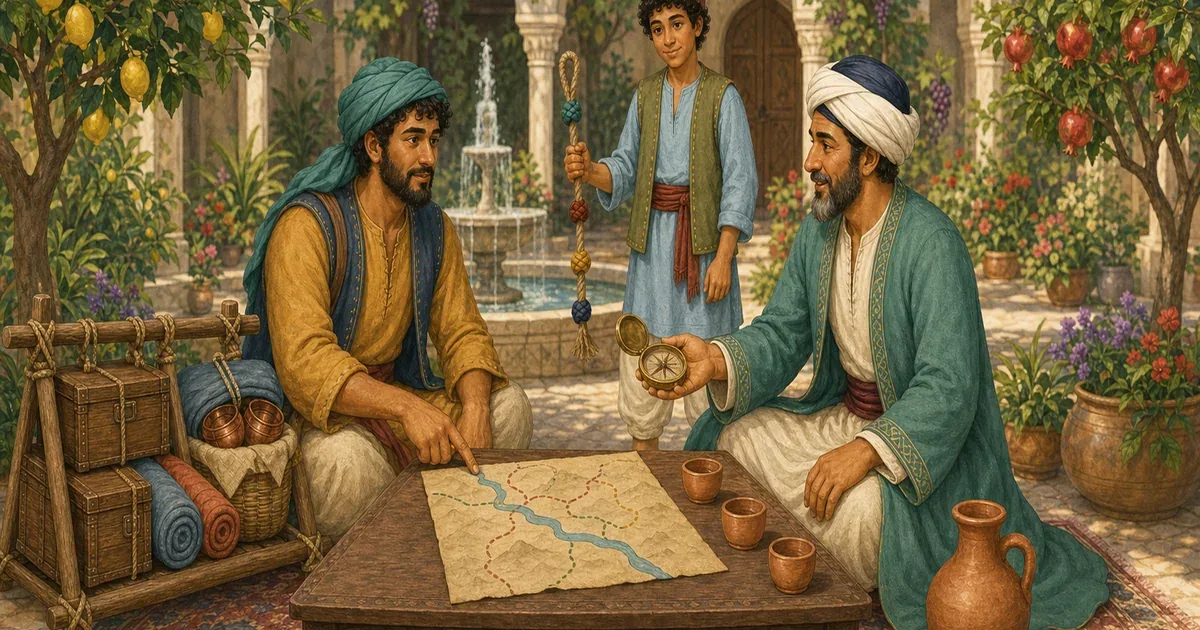
On a bright summer morning in Baghdad, Sinbad the Porter carried two boxes of books, rolls of cloth, and a basket of copper bowls. He knew the shortest alleys, the least crowded bridges, and the houses that left water jars for travelers.
By midday, the heat pressed down on the city. Sinbad found a broad tree outside a beautiful house and lowered his bundles onto their sturdy wooden frame. He drank from his bottle and rested in the shade.
Beyond the wall he heard a fountain and the soft music of an oud. The breeze carried the scent of lemon leaves and roses. Sinbad looked at his dusty sandals and the carved gate.
I walk all day and know Baghdad stone by stone, yet I return to one small room. The owner of this garden rests beside a fountain. Is work measured by what it leaves in the hand, or by how tired it leaves the worker?
He did not dislike the person inside. He was simply wondering why comfort was not shared evenly.
An Invitation Through the Gate
The gate opened. A young garden apprentice named Tariq set a cool water jug in the shade.
My employer heard you, he said. He would like to invite you in, if you wish. We can record your parcels and keep them on a dry shelf while you rest.
The porter hesitated.
My clothes are covered in road dust.
Dust proves that you traveled, Tariq replied. It is not a reason to close a door.
After counting and recording his bundles, Sinbad entered. Lemon, pomegranate, and grape plants surrounded a high fountain. The owner came to greet him standing, not from a raised chair.
Welcome. I am Sinbad the Sailor.
The porter stared.
I am Sinbad too, but my sea is made of Baghdad streets, and my waves are fruit carts.
The sailor laughed and offered his hand.
Then we are two Sinbads, each with a road he understands.
They sat in the shade. Food and water were offered to the porter as a guest, not as someone allowed to watch a feast from a distance. The sailor asked about his work. The porter explained how he balanced boxes, protected books from rain, and chose a route according to time, crowds, and temperature.
That is knowledge I never learned at sea, the sailor said.
The porter answered honestly:
And I do not understand how your journeys led to this garden. People often say that anyone who works hard will reach the same place. I work hard, but roads do not offer everyone the same opportunities.
The sailor did not pretend that effort alone explained his comfort.
You are right. I worked and planned, but crewmates helped me. Good decisions belonged to a team, and I received chances other people did not. Luck, timing, and support mattered. A fine house does not make its owner more worthy, and dusty clothes do not make a porter less worthy.
A Morning of Stories
The sailor invited the porter to return the next morning after his early deliveries.
I shall tell you about a voyage that taught me something. Then you must tell us a story from the roads of Baghdad.
Tariq, several neighbors, and the gardeners gathered near the fountain. The sailor placed a brass compass, an unmarked route map, and a rope with colored knots on the table.
We once sailed near an unfamiliar coast when thick fog covered everything, he began. Every sound seemed to come from a different direction. One sailor wanted to race forward until we escaped the fog, but speed without sight would have multiplied the danger.
The crew reduced the sails and divided the work. One watched the compass. Another measured water depth with a safe weighted line. A third rang a small bell at regular intervals so nearby boats could locate them. The youngest apprentice noticed seabirds carrying fresh green grass in one direction.
Quiet land may be close that way, the apprentice suggested.
They did not follow the birds alone. They compared their flight with the compass, depth, and wind. Moving slowly, they found a sheltered cove and waited there until the fog lifted.
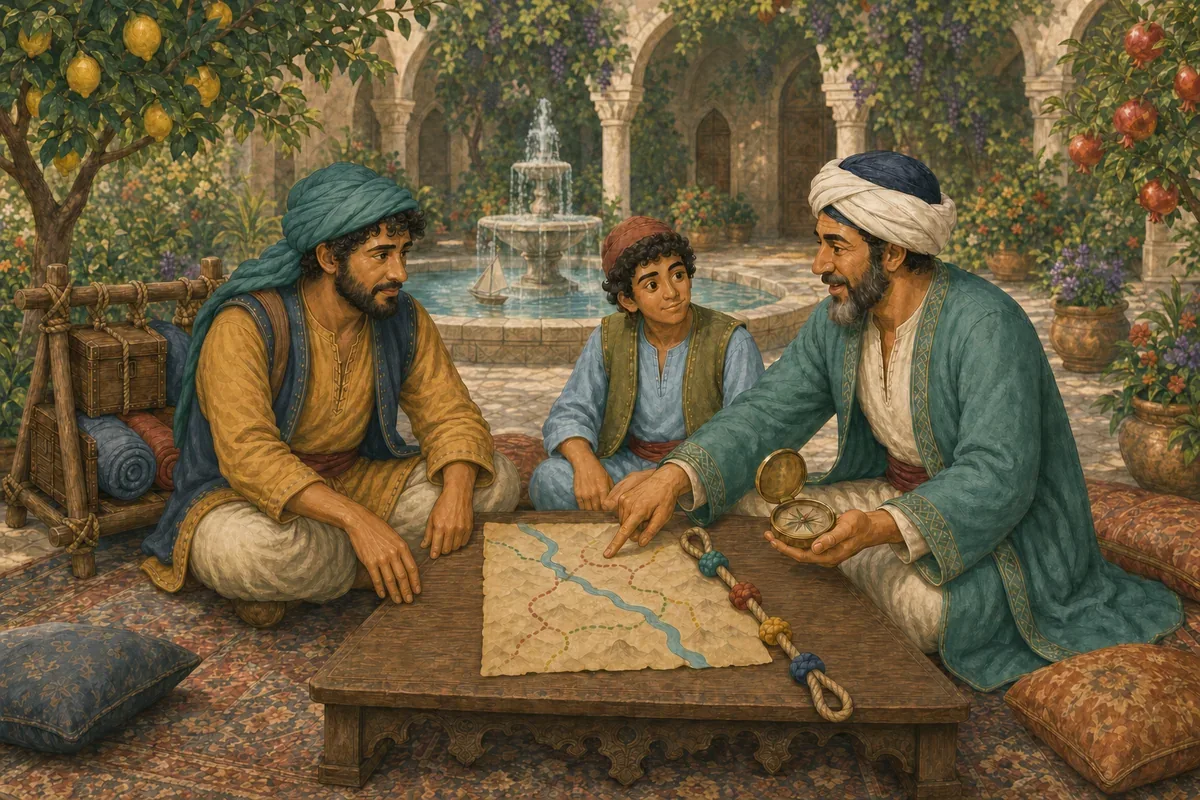
No single hero saved us, said the sailor. A team combined several small observations.
The porter lifted the knotted rope.
That sounds more like my work than I expected.
An Ocean of Alleys
Sinbad the Porter told them about a day when Baghdad's main bridge was closed for repairs. He was carrying fragile pottery, and several people urged him to hurry through a crowded market before sunset.
Instead, he stopped and checked every knot. He asked a baker about a quieter route, balanced the load into two groups, and invited another porter to share the crossing of a narrow footbridge. They delivered every bowl safely and divided the extra fee fairly.
Tariq smiled.
At sea you used compass, depth, wind, and birds. In the city you used ropes, local information, balance, and cooperation.
Courage is not always rushing into the unknown, the sailor said. Sometimes it is slowing down, asking questions, and changing the plan.
The sailor thought of workers who sometimes waited in full sun outside his gate.
What would make deliveries here safer and fairer?
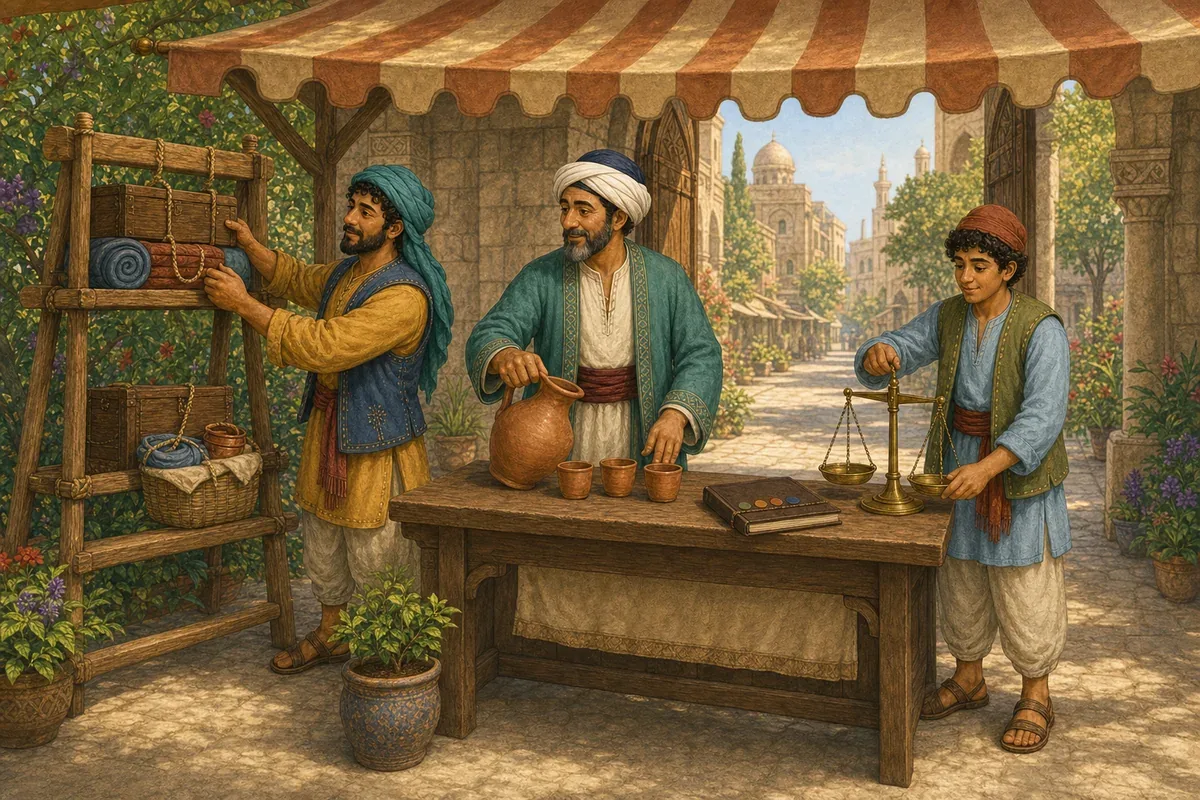
The porter suggested a shaded resting place, a clean water jar, a raised shelf to keep parcels off the ground, and a visible balance scale so everyone could agree on the load and fee before departure. Tariq added a simple receipt book to protect both the worker and the owner of the goods.
The sailor did more than admire the ideas. That week, he built the station by the gate and told every merchant he worked with to agree on clear pay and provide it on time.
Sinbad the Porter sometimes returned after finishing his work, not to ask for charity but to exchange stories. The sailor spoke of harbors and winds. The porter described bridges, markets, and the people who quietly helped travelers across the city.
One evening a guest asked:
Which Sinbad has the real adventures?
The sailor answered before the porter could speak.
A road is not measured by the amount of water around it. Anyone who carries responsibility, observes carefully, learns, and returns with useful experience has a story worth hearing.
The porter grinned.
Still, Baghdad's waves are more stubborn than yours. They sell watermelons and leave the peels in the road.
Everyone laughed. From then on, the gathering called them the two Sinbads: one knew the language of the sea, the other the language of the road, and both knew that experience grows when people share it with respect.
What Can We Learn?
- A person's value is not determined by a home, clothing, or wealth.
- Effort matters, but opportunity, luck, timing, and help also affect outcomes.
- Careful planning and teamwork can be braver than rushing ahead.
- A worker's everyday experience is real knowledge that can improve places and systems.
- Rest, water, clear agreements, and fair pay support safe and dignified work.
Discussion After Reading
- Why did Sinbad the Porter feel sad outside the house?
- How did Sinbad the Sailor welcome him respectfully?
- Which clues helped the crew navigate the fog?
- How was the sea story similar to the story of Baghdad's roads?
- Why did the sailor say that work alone did not explain every success?
- Which improvements did the porter suggest at the gate?
- What everyday knowledge do you have that could help someone else?