 English
 العربية
 Français
 Deutsch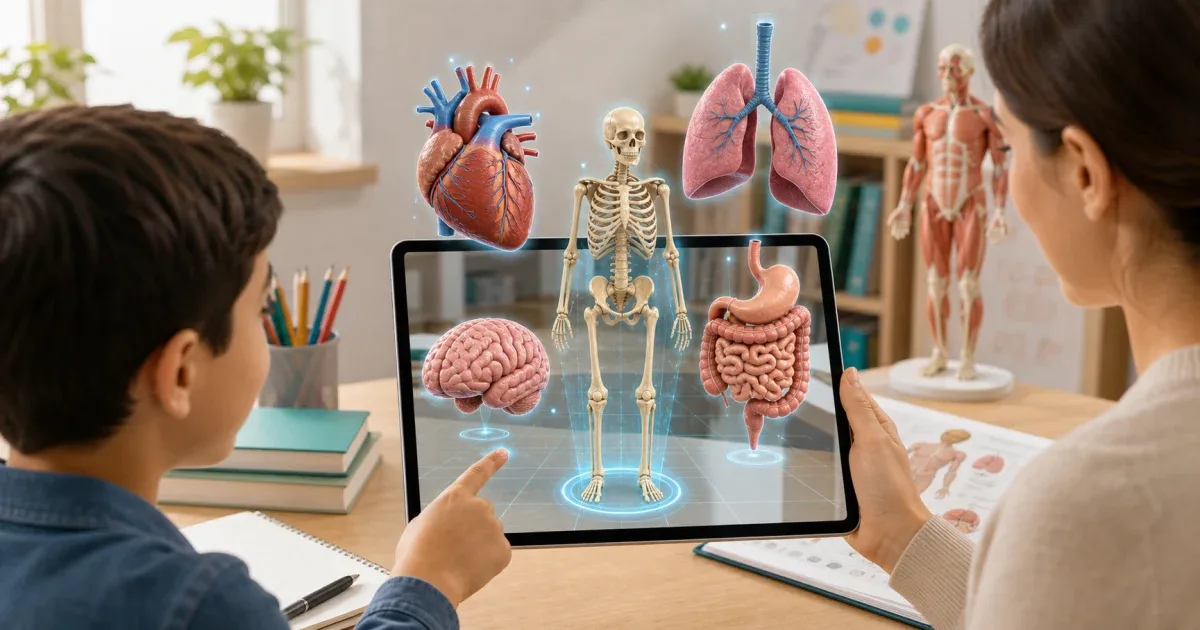
Why anatomy works well in AR
Human anatomy is easier to understand when learners can see organs as objects instead of flat drawings. A heart, skeleton, lungs, brain, or digestive system becomes clearer when students can rotate it, resize it, and view it from different angles.
Human Anatomy AR 4D uses augmented reality to place 3D anatomy models into the learner's real environment. This makes the app useful for students, parents, and teachers who want a visual way to introduce the human body.
What the app includes
The app organizes anatomy into external organs and internal organs or systems. External body parts include items such as arm, ear, eye, foot, hand, knee, leg, mouth, and nose.
The internal section includes a larger collection of 3D models: brain, heart, lungs, kidneys, liver, stomach, teeth, skeletal system, muscular system, nervous system, respiratory system, digestive system, urinary system, and more.
Some models include animation, such as a beating heart, which helps students connect the model with real function.
How students can use it
A student can choose a language, select an organ, and place the 3D model on a flat surface through the camera. Once the model appears, it can be scaled, rotated, and inspected from different sides.
This is useful for homework, science revision, and classroom explanation. Instead of memorizing names only, the learner can see where an organ is and how its shape relates to nearby systems.
The app also supports pronunciation in Arabic, English, and French. That is helpful when anatomy learning is also vocabulary learning.
Why parents and teachers may like it
AR anatomy gives teachers a simple visual demonstration without needing physical lab models. A parent can also use it at home to answer questions in a more concrete way.
The app is designed with a child-safe purchase flow using a parental gate, and most learning content works offline after installation. This makes it practical for home study or classrooms with limited internet.
If you need a broader AR learning collection for younger children, AR Kids Kit 4D covers many subjects beyond anatomy.
Practical learning ideas
Ask the learner to place the skeleton model and name major body parts. Then compare it with the muscular system or respiratory system.
Use the heart model to explain pulse, blood flow, and why exercise changes breathing.
Use the lungs and respiratory system to connect anatomy with everyday actions like running, speaking, or taking a deep breath.
For multilingual learners, repeat the organ name in more than one language and let the audio pronunciation reinforce memory.
Final recommendation
Use Human Anatomy AR 4D when anatomy needs to become visual, interactive, and easier to discuss. It is a practical app for science learning at home or in class, especially when students benefit from seeing 3D models rather than only reading diagrams.