 English
 العربية
 Français
 Deutsch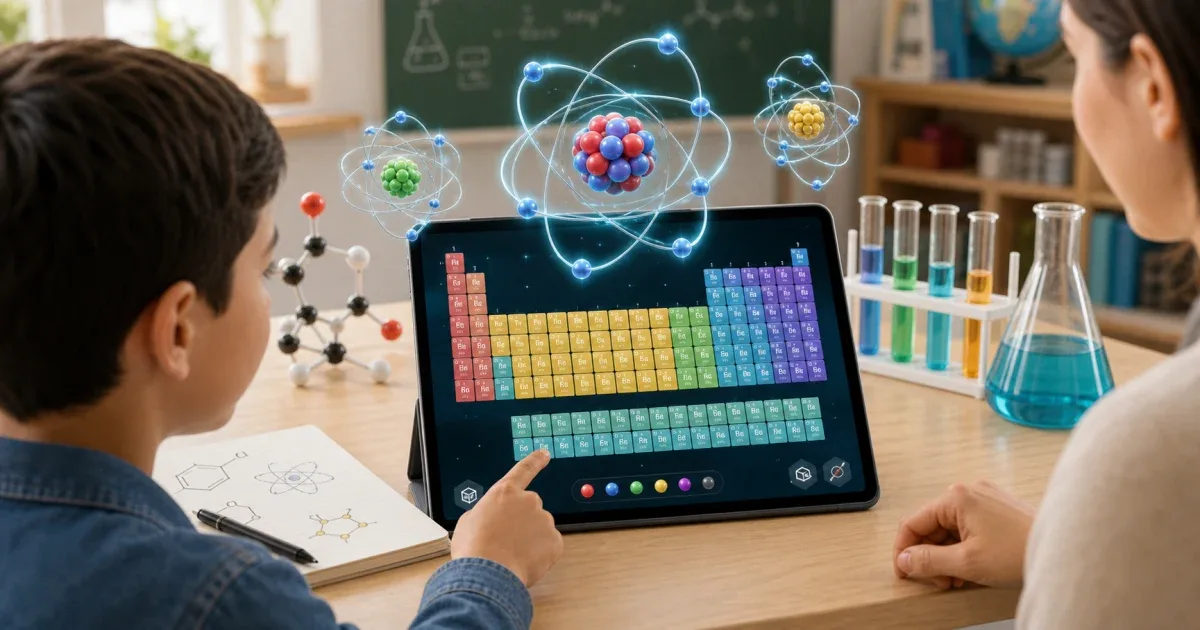
Why chemistry needs visuals
The periodic table can feel abstract when it is only a grid of symbols and numbers. Students may memorize element names without understanding atoms, particles, or why elements are grouped together.
Periodic Table AR 4D makes the table more visual. It includes all 118 chemical elements and lets students explore 3D atom models with protons, neutrons, electrons, and shell distribution. This helps chemistry become something to inspect, not only something to read.
What students can learn
The app organizes the periodic table by element groups such as noble gases, alkali metals, halogens, lanthanides, and actinides. Each element includes its symbol, atomic number, type, and particle information.
When a student taps an element, the app can show a 3D atom model. Seeing the nucleus and electron orbits makes the idea of atomic structure easier to explain in class or at home.
The app also includes audio narration in Arabic, English, and French, which is useful for learners who need both visual and listening support.
Where augmented reality helps
AR is useful when a learner needs scale, movement, and attention. A 3D atom placed on a desk is easier to discuss than a small textbook illustration. Students can rotate, move, and resize models to understand them from different angles.
The app also includes extra science content, such as solar system models and human anatomy models, so it can support more than one science topic. For body systems, Human Anatomy AR 4D is a related app with a deeper anatomy focus.
Practical classroom ideas
Ask students to compare two elements from different groups and describe what changes in their atomic models.
Use noble gases and alkali metals to discuss why groups matter.
Let students take screenshots of AR models for revision notes or classroom presentations.
Switch languages when students need to learn scientific vocabulary in Arabic, English, or French.
Final recommendation
Use Periodic Table AR 4D when chemistry needs to become more visual and interactive. It is especially useful for students who understand science better when they can see and manipulate 3D models instead of only reading a table.