 English
 العربية
 Français
 Deutsch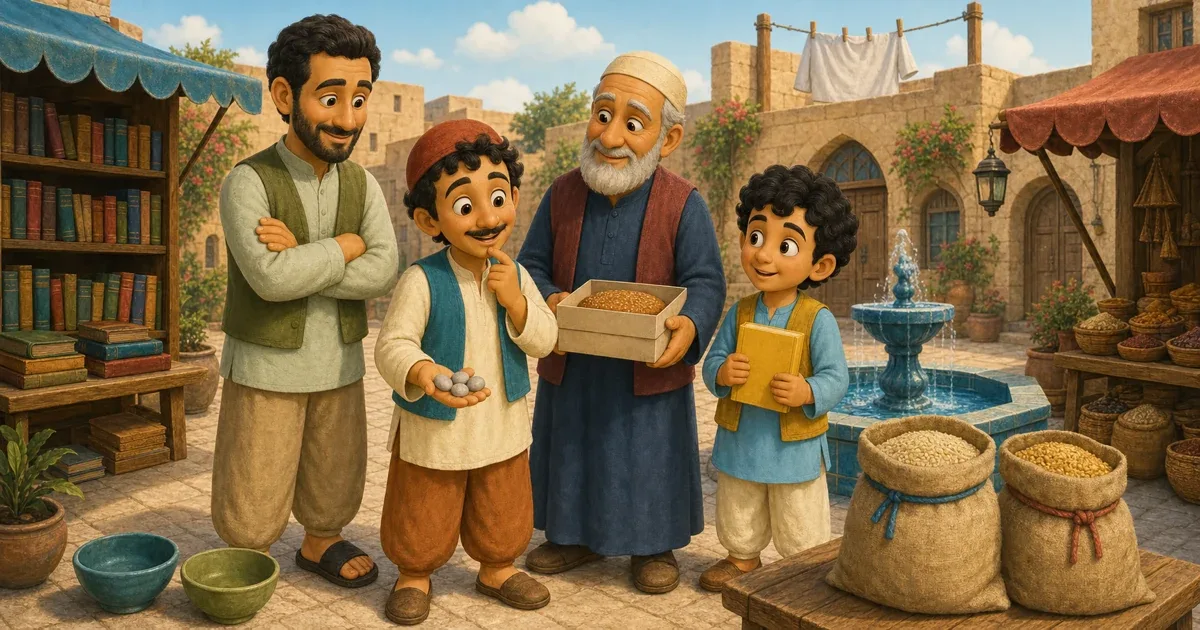
Abu al-Ghusayn was a cheerful man who lived with his father and his little brother Sami in Jasmine Lane. His neighbors liked him because he was helpful and laughed easily. He had only one troublesome habit: the first idea that popped into his head often became, in his mind, the only possible answer.
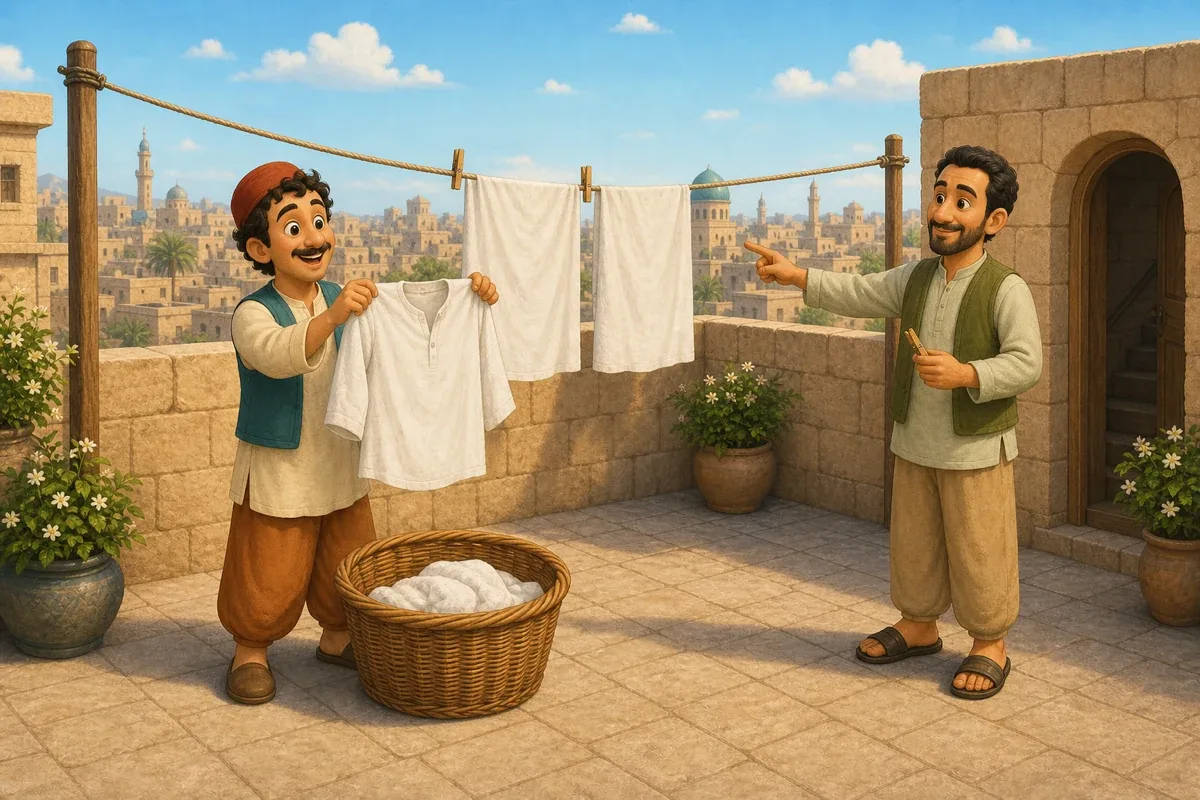
One windy morning, he hung his white shirt on the rooftop clothesline with a single peg. The moment he turned around, the wind lifted the shirt and dropped it neatly into the laundry basket below.
Abu al-Ghusayn leaned over the safe terrace wall and cried:
What a great fall I have escaped!
His neighbor Salim came up the stairs.
What fall? I see a shirt in a basket.
Abu al-Ghusayn held up the shirt.
If I had been wearing it, I would have fallen off the line with it!
Salim looked at the line, the lonely peg, and his friend.
You are not normally hung on a clothesline. The shirt fell because one peg was not enough. Before worrying, ask what actually happened.
Abu al-Ghusayn inspected the unharmed shirt and laughed.
What actually happened is that my shirt reached the basket before I did. Next time, I will use two pegs.
The Cake with a Window
That afternoon, his father gave him some coins.
Please bring home a round date cake for us to share after lunch.
Abu al-Ghusayn left the bakery carrying a warm sesame cake. It smelled wonderful. "I should taste a tiny bit of the filling," he thought. "I need to make sure it is good."
One taste became two. By the time he reached home, the entire soft center was gone.
He placed the outer ring before his father.
The bakery seems to be making cakes with large windows today.
His father looked at the date crumbs on Abu al-Ghusayn's mustache.
Was the window there when you bought it?
Abu al-Ghusayn nearly invented another answer. Then he remembered Salim's question: What actually happened?
The truth is that I ate the filling. I called the first bite a test, and then I did not stop. I am sorry.
His father nodded.
A funny excuse may make us smile, but it cannot repair the cake. Honesty is the first step. Making things right is the second.
Abu al-Ghusayn used his own coins to buy another cake. This time he carried it in a closed box and waited until everyone sat at the table. The piece he shared honestly tasted better than all the secret bites on the road.
Fingers Are Not Grain Bins
At the market, a grain seller asked Abu al-Ghusayn for help.
I have two sacks of barley and two sacks of wheat. How many sacks are there altogether?
Abu al-Ghusayn folded two fingers for the barley and two for the wheat. He kept his middle finger standing between the groups.
Why did you leave that finger out? asked the seller.
So the wheat does not mix with the barley.
Salim, who was buying flour nearby, placed two small bowls on the counter. He put two pebbles in one bowl and two in the other.
The grain stays separate because it is in different sacks. Numbers stay clear when we organize them. Two plus two makes four.
Abu al-Ghusayn counted the pebbles and then the sacks.
Four! Fingers are useful, but they are poor grain bins.
From then on, he used pebbles or another clear system when helping with sums, and he checked every answer twice.
The Description That Found Sami
That evening, Abu al-Ghusayn, Sami, and Salim visited the neighborhood book market. Before entering, they agreed on a safety rule: stay together, and if anyone became separated, wait at the blue fountain for a familiar adult.
Abu al-Ghusayn became busy counting picture books for a seller. When he looked up, Sami was no longer beside him.
He called out:
Has anyone seen a boy whose father wears a cinnamon-colored cap?
Salim spoke calmly.
You are describing his father, not Sami. What do we know about Sami himself?
This time Abu al-Ghusayn paused before speaking.
He is seven, with short black curls. He wears a blue shirt and a yellow vest and carries a yellow picture book. I last saw him near the bookstall.
They went straight to the blue fountain. Sami was waiting there with his book, exactly as they had agreed.
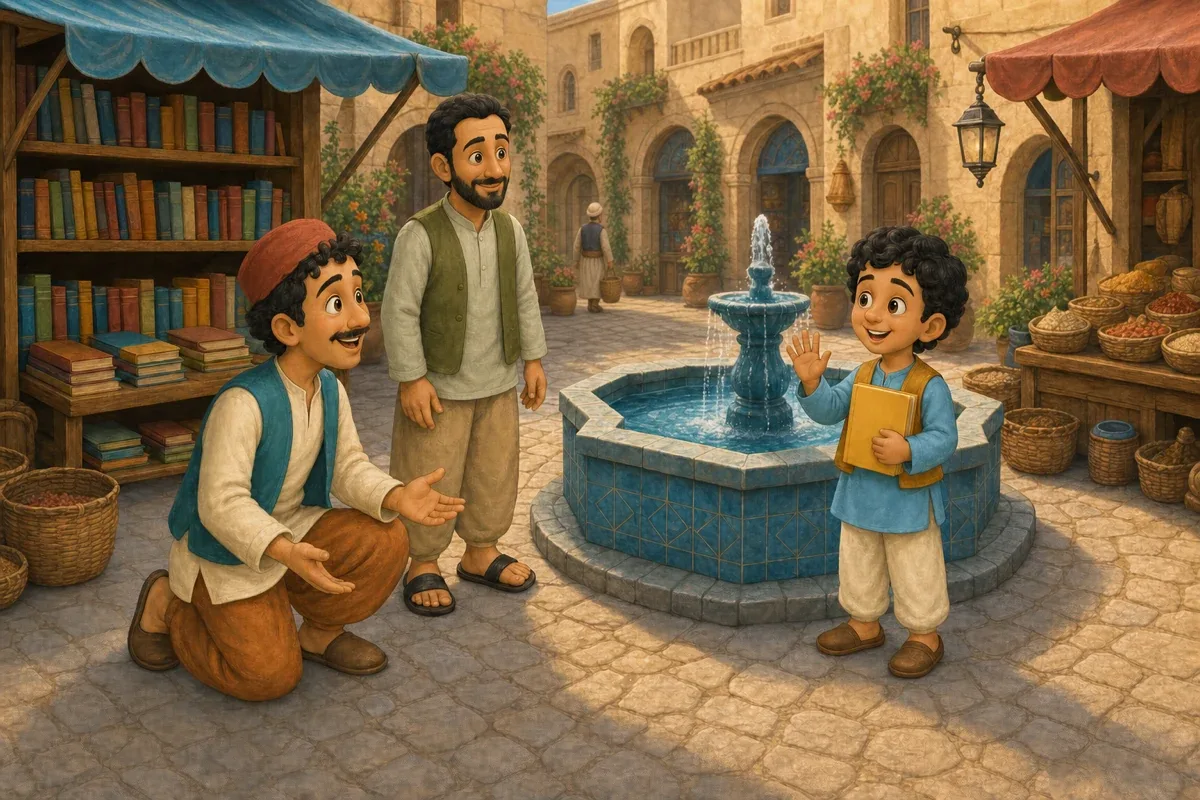
A picture caught my attention, Sami explained. Then I could not see you, so I came to our meeting place.
Abu al-Ghusayn knelt in front of him.
You followed the rule perfectly. I learned that a useful description tells us about the person we are finding, not about his father's hat.
The three walked home together. On the way, Abu al-Ghusayn counted the day's discoveries.
A shirt cannot pull its owner off a clothesline. Cakes are not born hollow. Fingers do not separate wheat from barley. And a father's cap is not his son's description.
Salim smiled.
Is there one rule that helps with all four?
Abu al-Ghusayn raised three fingers.
Stop, observe, and tell the truth.
He remained as cheerful as ever, but from that day he added one quiet moment of thought before each grand explanation. That little pause saved him many excuses and helped him solve problems more clearly and kindly.
What Can We Learn?
- The first explanation we imagine is not always correct.
- Telling the truth is better than inventing a clever excuse.
- Organizing information makes counting and problem-solving easier.
- A useful description names details about the person or object we mean.
- A known meeting place helps children act safely if they become separated.
Discussion Questions
- Why did Abu al-Ghusayn's shirt fall from the line?
- What did he do when his father asked about the cake filling?
- How did the bowls and pebbles make the grain count clearer?
- What was wrong with Abu al-Ghusayn's first description of Sami?
- Why was waiting at the fountain a good choice?
- Try Abu al-Ghusayn's rule: stop, observe, and say what actually happened.