 English
 العربية
 Français
 Deutsch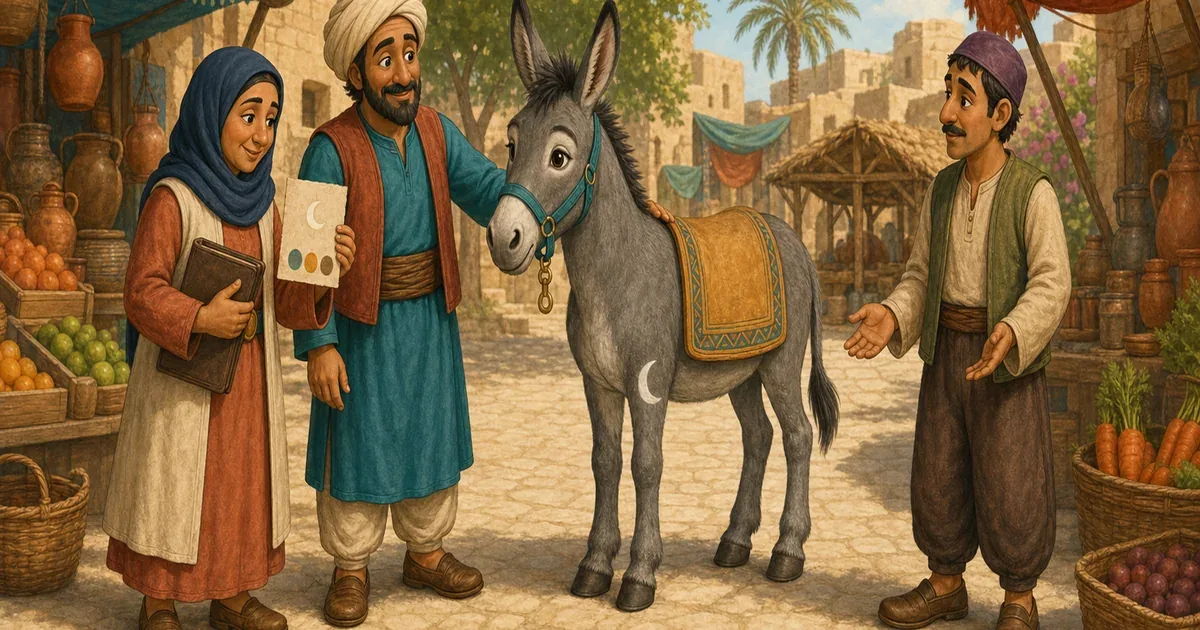
Every market day, Juha carried bundles of reeds to his workshop and stacks of finished baskets back to the village square. One evening, he rubbed his tired shoulders and announced:
I need a sturdy helper. Buying a new pair of shoulders every week would be far too expensive.
At the animal market he found a small gray donkey with patient eyes. A white crescent-shaped patch marked the animal's left front leg, and a saffron-colored woven blanket rested across his back.
Juha watched the donkey walk, checked that his hooves looked healthy, and offered him water. The donkey drank calmly and turned both long ears when Juha spoke.
I shall call you Olive. You have the peaceful look of an olive tree on a windless morning.
Noura, the market steward, recorded the sale. She described the crescent patch, the saffron blanket, and the teal halter on the receipt, stamped it, and handed Juha a copy.
Keep this safe, and check on your companion as you travel. Holding a lead is not the same as paying attention to the animal behind you.
Juha tucked the receipt into an inner pouch, took the handle of Olive's lead, and set off for home.
The Lead Without a Donkey
The road was crowded with fruit carts and basket sellers. Juha marched ahead, happily calculating how many heavy journeys Olive would save him.
A dishonest man named Mazen noticed that Juha never looked back. Mazen whispered to a companion:
Take the donkey down the side lane. I will keep the loose end moving so Juha sees a shadow behind him.
Mazen quietly released the safety clip. His companion tempted Olive away with a carrot and led him back toward the market. No one struck or frightened the donkey, but Olive followed the food because Juha had stopped speaking to him.
Mazen held the empty clip and walked several steps behind Juha. From a distance, the swinging lead still appeared to end at a traveler.
At the village fountain, Juha finally turned to greet Olive. He saw no gray muzzle, long ears, or crescent patch. Instead, a man stood holding the empty clip and wearing a sorrowful expression.
Where is Olive? Juha cried. And why are you holding my donkey's lead?
Mazen sighed.
I am the donkey you bought.
Juha blinked.
You are Olive? Your ears have become remarkably short.
Mazen invented an extraordinary explanation. He claimed that he had once broken too many promises to his mother. She had wished that he would learn patience, and he had somehow become a donkey. Juha's kind voice, Mazen said, had finally changed him back into a man.
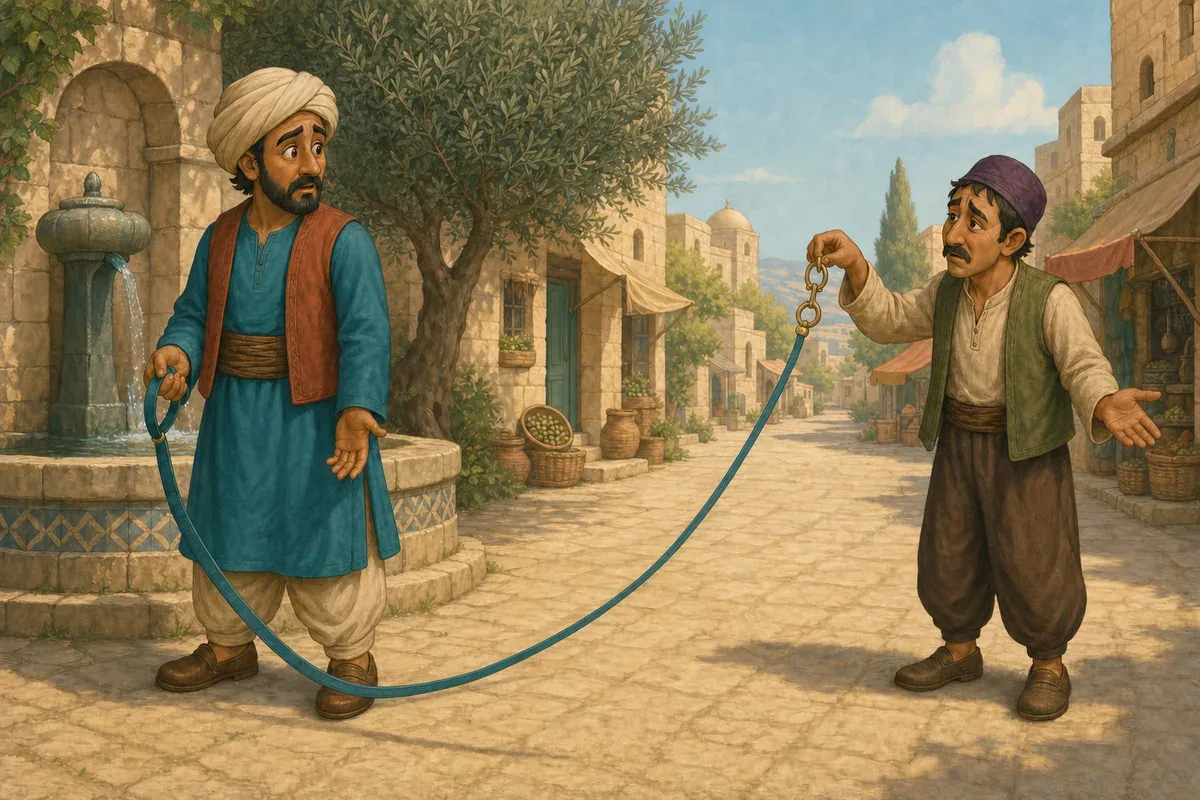
For a moment, Juha felt sorry for him. He handed Mazen the lead.
Go home, apologize to your mother, and keep your promises this time.
Mazen thanked him and hurried away before Juha could think of another question.
Questions Arrive Late
Juha reached home without a helper. While emptying his pouch, he unfolded the receipt and read Noura's careful description: gray donkey, white crescent above the left front leg, saffron blanket, teal halter.
If Olive turned into a man, what happened to the crescent patch? Juha wondered. Did the blanket turn into clothing? And why does this receipt describe a perfectly ordinary donkey?
The strange tale had been full of emotion but empty of evidence. Juha realized that he had accepted an amazing claim because he had not paused to ask simple questions.
He did not run into the streets to chase Mazen by himself. Instead, he placed the receipt back in his pouch and decided to speak to Noura in the morning. She had the official market record and knew how to handle disputes without a dangerous confrontation.
The next day, Juha arrived early. Before he reached Noura's desk, he heard a familiar bray. There at the edge of the market stood Olive, wearing the same saffron blanket and showing the same white crescent.
Juha leaned close and whispered:
Did you break your promise to your mother already? You have turned back into a donkey very quickly.
Olive lifted his ears and brayed again.
Juha started to walk away, shaking his head. Then he stopped.
Wait. You did not become a man. I nearly became careless twice.
Juha did not grab the seller or begin an argument. He called Noura, showed her the receipt, and pointed out the crescent patch. Noura compared the animal's halter and blanket with the record.
This is Olive, she said firmly. He was sold to Juha yesterday. No one has the right to sell him again.
Evidence Is Shorter Than a Tall Tale
Noura asked the new stallholder who had brought the donkey. He pointed toward Mazen and his companion near the market gate. Noura asked the market guards to invite both men to her office calmly.
Faced with the receipt, the identifying mark, and the sale record, Mazen could not repeat his magical story. He admitted the trick, returned the buyer's money, and apologized to Juha.
The market council required the two men to spend several supervised days cleaning the animal shelter and carrying feed. They needed to understand that an animal is a living responsibility, not an object to take with a clever performance.
Noura returned the lead to Juha. She checked that its clip was comfortably attached to Olive's halter, never tightened around his neck.
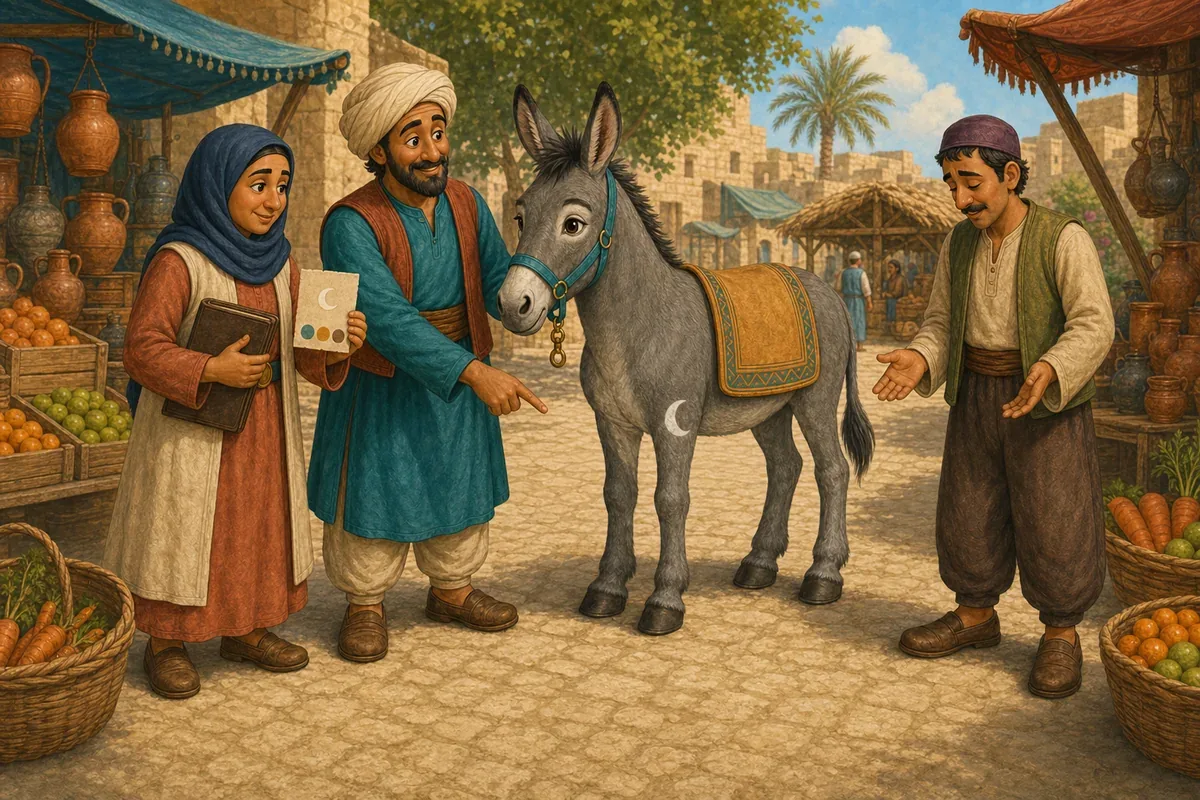
A surprising story can touch our hearts, Noura said, but kindness and careful questions belong together.
Juha patted Olive gently.
From now on, I shall talk to you on the road, look back often, and keep my receipt. And if a man says he used to be my donkey, I shall ask him about the crescent patch first.
They walked home slowly. Every few steps Juha called Olive's name, and Olive answered with a short bray. At home, Juha wrote three reminders on a card for his pouch: notice, verify, ask for help.
Olive received fresh water, hay, and a small carrot. As for Juha, people say he never again walked far without checking behind him, even when the only thing following him was a sack of onions.
What Can We Learn?
- An extraordinary claim needs evidence, even when the speaker sounds convincing.
- Receipts and distinctive details can help prove ownership.
- Caring for an animal means observing it, speaking to it, and using comfortable equipment.
- When we suspect a trick, we should ask a responsible adult or official for help instead of confronting someone alone.
- Admitting a wrong and repairing the harm is better than adding another lie.
Discussion After Reading
- Which detail helped Juha identify Olive?
- What made Mazen's story doubtful even before the donkey reappeared?
- Which questions could Juha have asked at the fountain?
- Why did Juha speak to Noura instead of confronting the men alone?
- How did the receipt help settle the disagreement?
- Can we feel compassion for someone and still ask for evidence? Explain.
- Which of Juha's reminders is most useful to you: notice, verify, or ask for help?