 English
 العربية
 Français
 Deutsch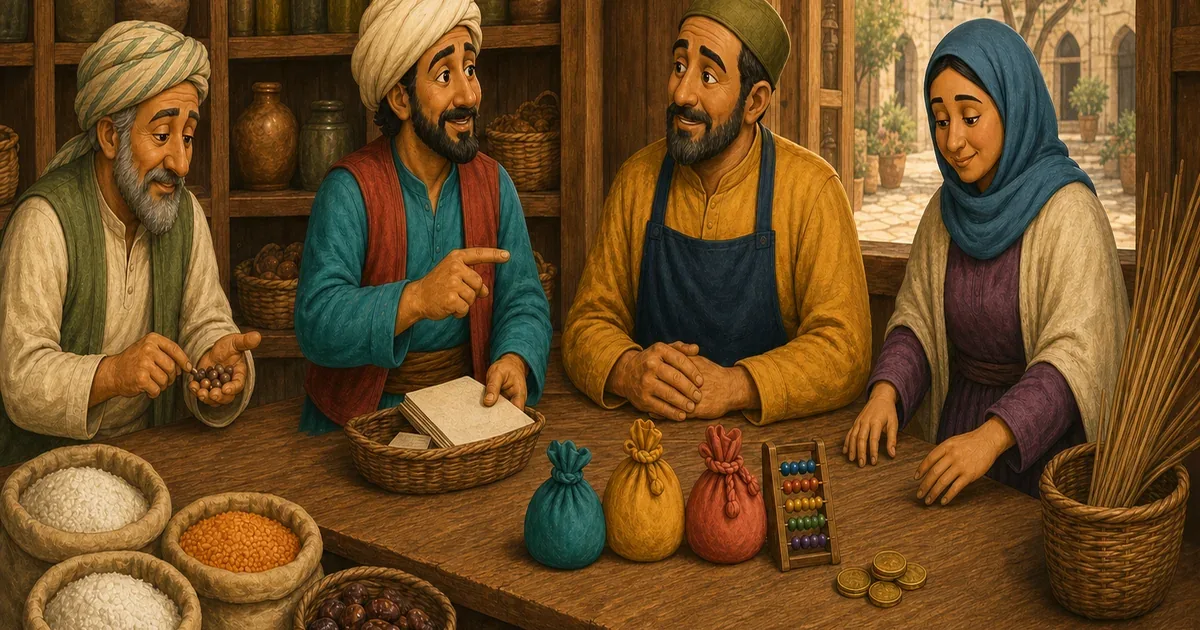
Juha earned his living by weaving baskets for the village market. During one unusually quiet week, he sold only a single basket, while his household still needed flour, lentils, oil, and dates.
At Salim's grocery shop, Juha placed the coins he had on the counter.
Please give me only what this can buy. I will wait for the rest.
Salim knew the food was essential.
Take what you need today, and we will record the difference as credit. Let us be clear from the start: the balance is fifty dirhams. If your payment date changes, tell me early.
Salim wrote the amount in his ledger, and Juha added his mark to show that he had checked it. Juha left with flour, lentils, oil, and dates, intending to pay after the following market day.
That market was quiet too. Embarrassed, Juha told himself he would wait until he had the entire sum and surprise Salim with good news instead of bringing him a problem.
The Long Way Around
One week passed, then another. Whenever Juha spotted Salim at the end of the road, he turned into a side alley. If he heard the grocer's voice at the market, Juha suddenly became deeply interested in checking the ropes on his baskets.
The debt did not become smaller. It simply occupied more of Juha's thoughts, and every alternative route took longer.
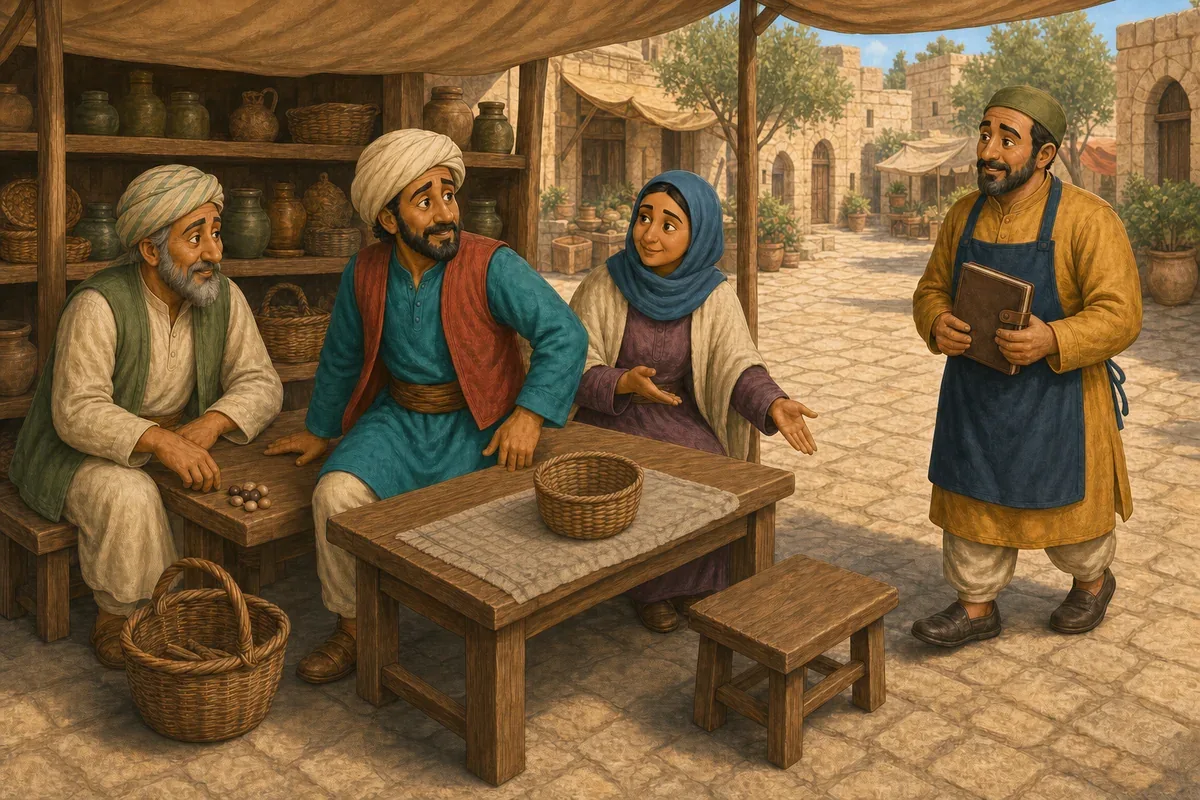
One afternoon, Juha sat with his friends Hamid and Maryam near the market square. He was halfway through a funny story when he saw Salim approaching with the account book.
Juha stood quickly.
I just remembered that I must inspect the shade of a very distant tree.
Maryam shook her head.
The shade will wait. The matter you are avoiding has already reached this table.
Juha sat down again. Salim arrived and spoke quietly.
I did not come to embarrass you. I need to know when payments will begin because I must pay my suppliers too.
Juha's Five-Dirham Trick
Juha glanced at his friends and put on his most confident expression.
Salim, I owe you fifty dirhams, correct?
Correct.
I will give you twenty-five after Thursday's market and twenty after the next one. How much remains?
Five dirhams.
Juha smiled as if he had solved a great puzzle.
Then why trouble me over only five dirhams?
Hamid did not laugh. He placed fifty small counting beans on the table. He moved twenty-five to one side and twenty to the other, but kept every bean in front of Juha.
These forty-five are still here. You have promised them, but you have not paid them. Arithmetic can describe a plan; it cannot change what Salim has received today.
Maryam added:
If you do not know where the two payments will come from, they are not a plan yet. They are wishes wearing numbers.
Juha studied the beans. The final five looked small, but the other forty-five had never disappeared.
Salim said:
I do not expect the impossible. I need dates connected to income you can reasonably earn, even if the payments must be smaller.
Juha sighed.
You are right. I used a joke because I was ashamed that sales had gone badly. I should have come to you instead of making both of us walk around the market looking for each other.
Three Colored Pouches
Juha opened his sales notebook. He could weave two small baskets each week. After replacing his materials, one sale usually left ten dirhams available.
Together, they created a realistic plan:
- twenty-five dirhams from a large order Juha would deliver in four days;
- twenty dirhams from the next two market weeks;
- the final five from his small-coin box, without using money needed for household food;
- an early conversation with Salim if an order or market was delayed.
Maryam gave him three cloth pouches: blue for the first payment, saffron for the second, and coral for the last. Different knots made them easy to identify.
Hamid gave one final rule:
Never place a promise in a payment pouch. Put in money you have actually received.
Juha laughed.
My promises must have been very light. They floated out of my notebook before reaching Salim.
From Fifty to Zero
Four days later, Juha completed the large order. He placed twenty-five dirhams in the blue pouch and took it to Salim, who recorded the payment and gave him a receipt.
At each of the next two markets, Juha put ten dirhams into the saffron pouch. He postponed unnecessary purchases until that payment was complete.
Five dirhams remained. It would have been easy to call them unimportant, but Juha now understood that a debt does not vanish because its final part is small. He collected spare coins until the coral pouch was ready.
At the shop, he placed five coins on the counter.
Here are the five dirhams I tried to make responsible for the entire fifty.
Salim counted them, closed the account in the ledger, and moved the beads on his wooden abacus until the balance reached zero.
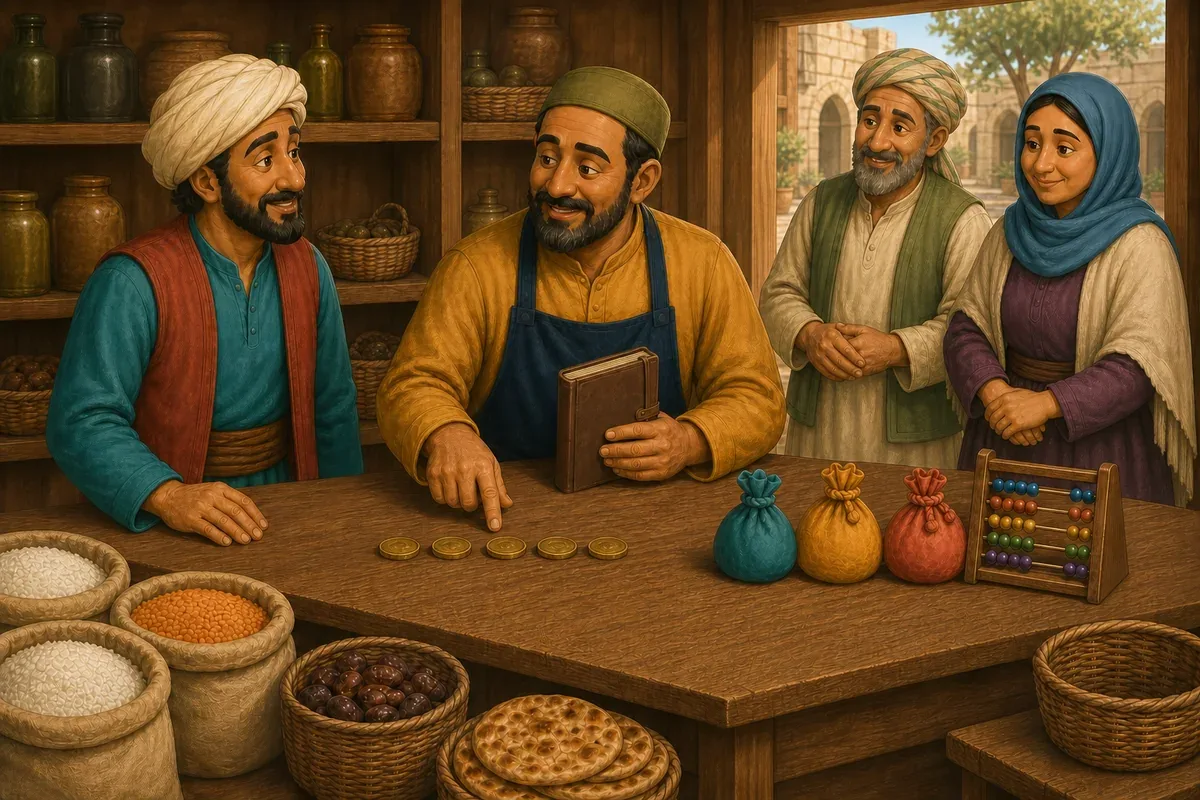
The final five matter, Salim said, but what restored my trust was your steady payments and honest communication.
And I learned that the shortest road in the village is the one that goes directly through the problem, Juha replied.
Hamid and Maryam laughed. This time, Salim laughed with them, not at anyone's expense.
From then on, whenever Juha needed credit, he confirmed the amount, date, and plan before leaving the shop. If circumstances changed, he spoke early. He saved the long alley for peaceful walks instead of escape routes.
What Do We Learn?
- A debt is a responsibility and a clear agreement, not a number that disappears in a joke.
- Promised money is not the same as money already paid.
- Early communication is better than avoidance and embarrassment.
- A useful repayment plan is based on realistic income and protects essential needs.
- Records and receipts help both people know what has been paid and what remains.
Discussion After Reading
- Why did Salim allow Juha to buy essential food on credit?
- Why did Juha begin taking the longer road?
- What was wrong with the “only five dirhams remain” trick?
- What made the repayment plan realistic?
- How did the pouches and receipts help?
- What should someone do if they know they cannot meet an agreed payment date?